



Case Study
A semiconductor customer required advanced underfill dispensing solutions to support next-generation packaging with increasingly complex geometries and tighter process constraints. The application environment combined multiple challenges including high aspect ratio structures, interposer layers, miniaturized components, ultra-small gaps, and large device formats. These evolving package designs required precise fluid control to ensure complete underfill coverage, prevent voiding, and maintain mechanical reliability across all device types.
A MAX-II Series high precision automated dispensing system capable of high accuracy and flexible process control was recommended to address the application challenges.
The proposed solution included:
This configuration enables consistent process conditions, optimized material flow, and improved throughput across complex assemblies.
High aspect ratio geometries were present in the form of tall components with small footprints and elongated rectangular devices. Stacked die configurations further increased process complexity.
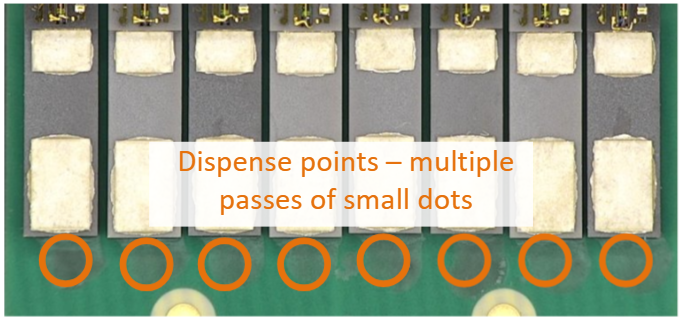
To accommodate limited dispense access, tilting of the dispense pump was utilized when traditional top-down dispensing was not feasible. In some configurations, sequential top-down dispensing was possible where sufficient surface area was exposed.
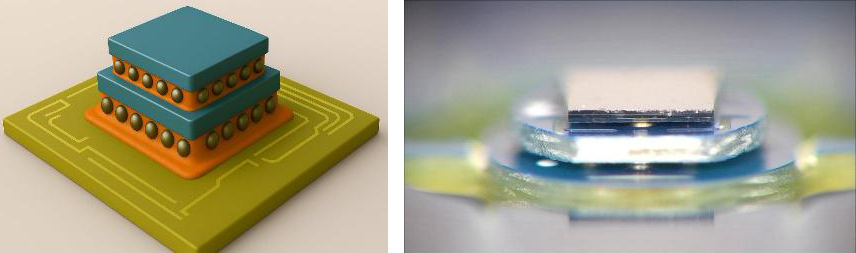
Interposer layers introduced additional complexity by acting as interfaces between die and substrate with non-uniform geometries.
These structures:
Their presence requires precise control of underfill flow to ensure full coverage across varying topographies.
Miniaturization required dispensing extremely small volumes with high repeatability.
Ongoing nozzle development with reduced internal diameters supports further reduction in droplet size for future applications.
Gap heights as small as 10 µm introduced stringent material and process requirements.
Key considerations included:
Maintaining a consistent flow front was critical to achieving complete and void-free underfill.
Components required higher dispense volumes while maintaining uniform distribution and flow consistency across extended distances.
Process optimization was required to balance volume delivery, flow time, and throughput without compromising quality.
Two primary dispensing technologies were evaluated for suitability across the range of application requirements.
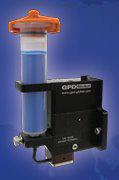
Recommended for:
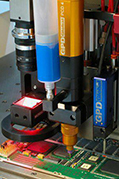
The increasing complexity of semiconductor packaging introduces significant challenges in underfill dispensing, including extreme miniaturization, tighter gaps, and more intricate geometries.
To address these challenges:
A combination of adaptable hardware and intelligent software is required to ensure reliable, repeatable, and high-quality underfill processes across diverse application conditions.
| Dispense System |
MAX-II Series High-precision automated dispensing platform with integrated thermal management, closed-loop control, and advanced process software. Key Capabilities:
|
|---|---|
| Dispense Pumps |
|
