



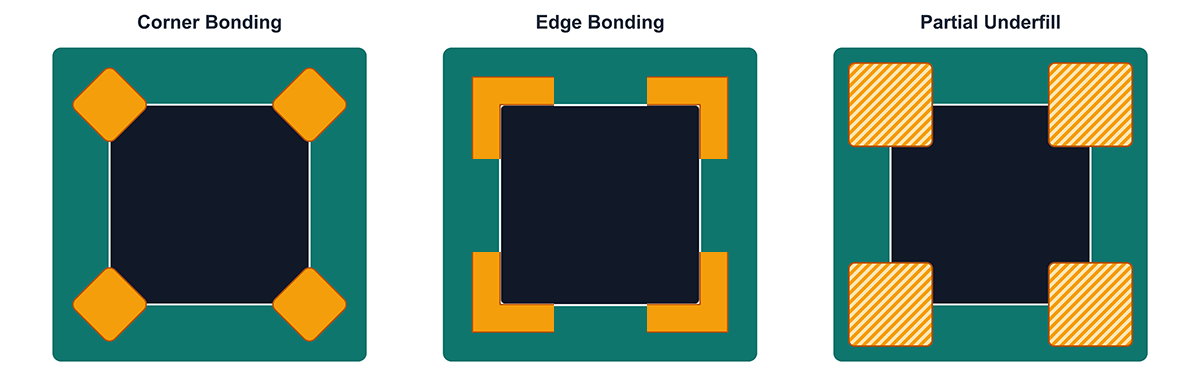
Edge bonding, corner bonding, and partial underfill are precision fluid dispensing processes used to reinforce electronic assemblies, protect solder joints, and improve reliability in high stress environments. By applying controlled amounts of adhesive or underfill only where reinforcement is needed, manufacturers can reduce material usage, improve throughput, and support consistent production quality.
As electronic devices continue to shrink while increasing in functionality, solder joints are exposed to greater mechanical and thermal stress. Precision fluid dispensing processes such as edge bonding, corner bonding, and partial underfill help electronics manufacturers improve long term reliability without the cost, material usage, and process complexity of full underfill.
These selective reinforcement methods strengthen solder joints, improve resistance to shock and vibration, and extend product life in demanding applications such as automotive electronics, medical devices, aerospace systems, industrial controls, and consumer electronics.
Edge bonding is a precision adhesive dispensing process used to reinforce surface mount components after solder reflow. During the edge bonding process, a controlled bead of adhesive is dispensed along one or more edges of a component, creating a strong mechanical bond between the component body and the printed circuit board (PCB). This targeted reinforcement helps protect solder joints from shock, vibration, and thermal cycling while using less material than full underfill.
For electronics manufacturers, automated edge bonding dispensing provides repeatable adhesive placement, consistent bead geometry, and accurate volume control. These process controls are especially important for high reliability electronic assemblies used in automotive electronics, consumer devices, industrial controls, medical electronics, and aerospace applications.
Corner bonding involves dispensing small amounts of adhesive at the corners of a component, creating localized reinforcement at the areas most susceptible to stress concentration.
Compared to edge bonding, corner bonding uses less material and typically requires shorter process times while still delivering significant mechanical support.
Partial underfill is a selective underfill process where encapsulant is applied only to critical regions beneath or around a component rather than fully encapsulating the entire package.
This technique provides reinforcement where it is needed most while maintaining higher throughput and lower material costs compared to traditional capillary underfill.
Automotive assemblies are exposed to continuous vibration, thermal cycling, and harsh operating environments. Edge bonding and partial underfill help protect solder joints in:
Portable devices are frequently subjected to drops and mechanical shock. Corner bonding and edge bonding are commonly used to reinforce:
Industrial environments often involve vibration, temperature fluctuations, and continuous operation. Selective underfill processes help improve reliability in:
Many medical electronics require exceptional reliability and long service life. Partial underfill and corner bonding can be applied to:
Aerospace and defense systems experience extreme vibration, acceleration forces, and temperature variation. Reinforcement techniques help protect:
The success of edge bonding, corner bonding, and partial underfill depends on precise placement and accurate volume control. Inconsistent dispensing can lead to inadequate reinforcement, excess material usage, or contamination of adjacent components.
Automated dispensing systems provide:
Whether dispensing small corner bond dots or complex partial underfill patterns, precision dispensing ensures consistent results across every assembly.
GPD Global dispensing systems deliver the accuracy, repeatability, and process control required for edge bonding, corner bonding, and partial underfill applications. Designed for high mix and high volume manufacturing environments, our dispensing solutions help electronics manufacturers improve product reliability while optimizing production efficiency.
Contact GPD Global to learn more about automated dispensing solutions for edge bonding, corner bonding, and partial underfill applications.
Read more about what is underfill
